Benefit

Manuka honey from New Zealand is known for its medicinal properties. It has been used for centuries as a natural remedy by the Maori people of New Zealand, as it has a very strong antibacterial effect and helps against a variety of ailments and diseases.

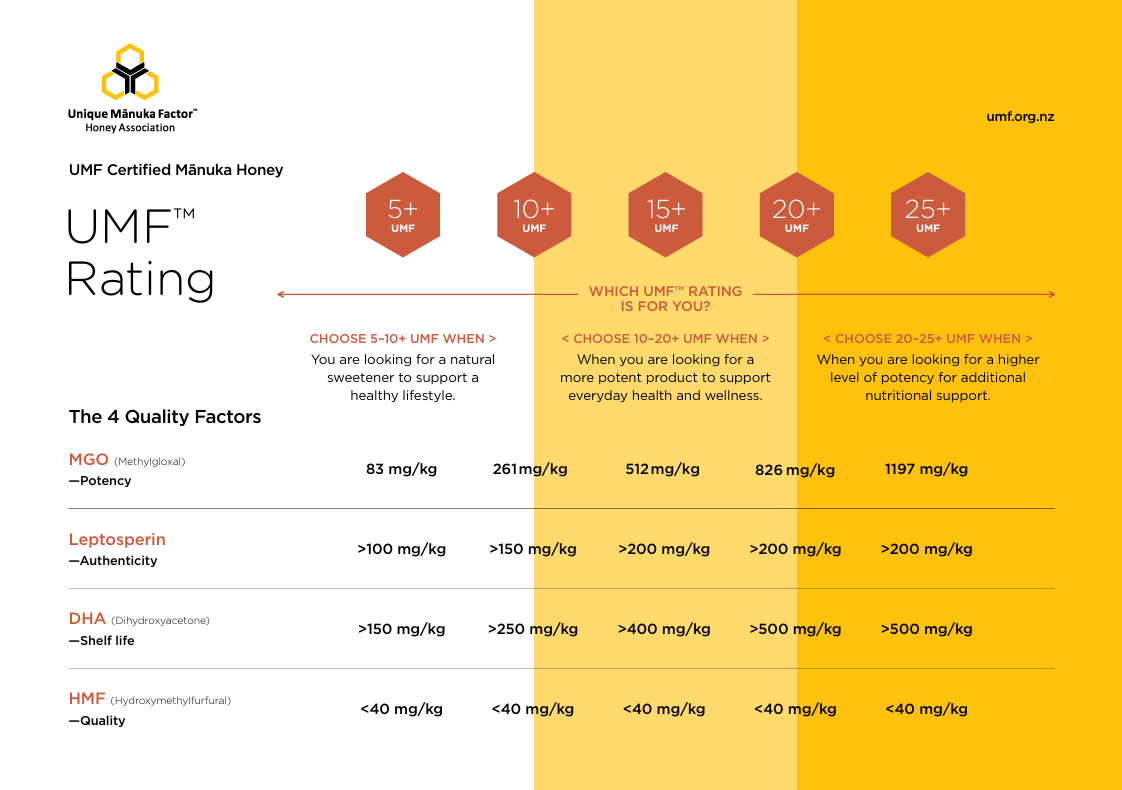
MGO and UMF

In order to be able to use Manuka Honey optimally, you should make sure to choose the MGO/UMF value that suits you. The following table helps with an overview of the effects:

Using Manuka Honey

Consumed in at least 60 countries around the world, New Zealand mānuka honey lovers have created their own ways of incorporating mānuka honey into their routines to support a healthy lifestyle.

Most popular may be enjoying it straight off the spoon closely followed by adding a spoonful to a favourite tea or even hot water.  It is used as a natural sweetener, particularly for a healthy cereal topping, added to smoothies, or anytime you want a delicious boost to your breakfast.

Mānuka honey is used in many countries as a natural skincare either directly on the skin, blended into a natural skin cream or as an ingredient in a store bought skincare product (always look for the UMF™ quality mark).

Whether sucking on a lozenge, a lollipop or savouring a dollop on the tongue mānuka honey is well recognised for soothing sore throats and easing coughs.

Disclaimer

Since it is forbidden in Switzerland to report on the benefits and healing properties of a product, I am only permitted to provide very limited information on this topic.


However, if you are interested in this subject, you can find much more information on Google or go directly to the Official UMFHA Site, which regularly publishes new studies.

  • Cell-healing

    Manuka honey could help internally as well as externally in cell healing as well as cell renewal.

  • First aid for cough

    Eating 1-3 spoons a day could help with all types of coughs, such as a sore throat.

  • Antiinflamantory

    Manuka honey could help with inflammation in the mouth, as well as throughout the body, as it could be considered a natural antibiotic.

  • Woundhealing

    In the case of cuts, honey could be applied to the area and fixed with a plaster. This could allow the affected area to heal much better and faster.

  • Skin diseases and acne

    Apply honey to the desired area and let it soak for a minimum of 30 to 60 minutes. This could help to reduce Acne and Skin diseases.

  • Immune System

    Consuming 1-2 spoonfuls daily could help to strengthen the immune system and give you an extra portion of energy for the day.

  • Cystitis

    Manuka honey could help against bladder infections if it is prepared in the form of tea. As a result, the honey could get absorbed in the bladder and kidney area and could have an anti-inflammatory effect on the body.

Processing

Our raw Manuka honey is less processed than conventional honey. This means that it is not spun over a long period of time or heated above the normal hive temperatures (approx. 35 degrees Celsius). This results in a higher content of healthy enzymes while maintaining an unmistakable taste that can only be found
in raw Manuka honey.

Storage

-Temperatures: Manuka honey should be stored in a dark room with temperatures between 20 to 25 degrees celsius.

-Darkness: Light exposure can cause the breakdown of the honey’s beneficial compounds, so it should get stored be stored in a dark space.

-Shelf Life: If the honey stays clean it can be stored more than 100 years.

-Dryness: Moisture can lead to bacterial growth and honey spoilage. Therefore, its essential to store Manuka honey in a dry environment, away from moisture and dampness.

-Stability: Maintain stability by avoiding frequent temperature changes moving containers. Keeping the honey in its original jar helps preserve its consistency and quality. 

-Important: It should not be fed to children under 12 months.